


If you’ve ever examined a SmartPad installed on a line, you may have noticed a specific design feature: the bands sit exactly one inch from each end, leaving eight inches between them. At first glance, this might look like a “gap” in protection. You might even assume that there was no way that the seal could be maintained around the entire pad without more bands.
The SmartPad system isn’t a passive cover; it’s a dynamic mechanical assembly. Its ability to keep edges sealed, where most pipe supports fail, comes from a precise combination of material rigidity, geometric accuracy, and stored elastic energy.
The “Exact Fit” Advantage: Why Molding Beats Cutting
Edge stability begins with manufacturing. Most competitors create FRP wear pads by cutting down sections of standard FRP pipe. While cost-effective, this method leads to geometry misalignment: the inner diameter (ID) of a cut pipe would not exactly match the outer diameter (OD) of the process pipe.
Even a small mismatch causes imperfect contact—either “point loading” (where only the center touches) or “wing gapping” (where the edges lift away).
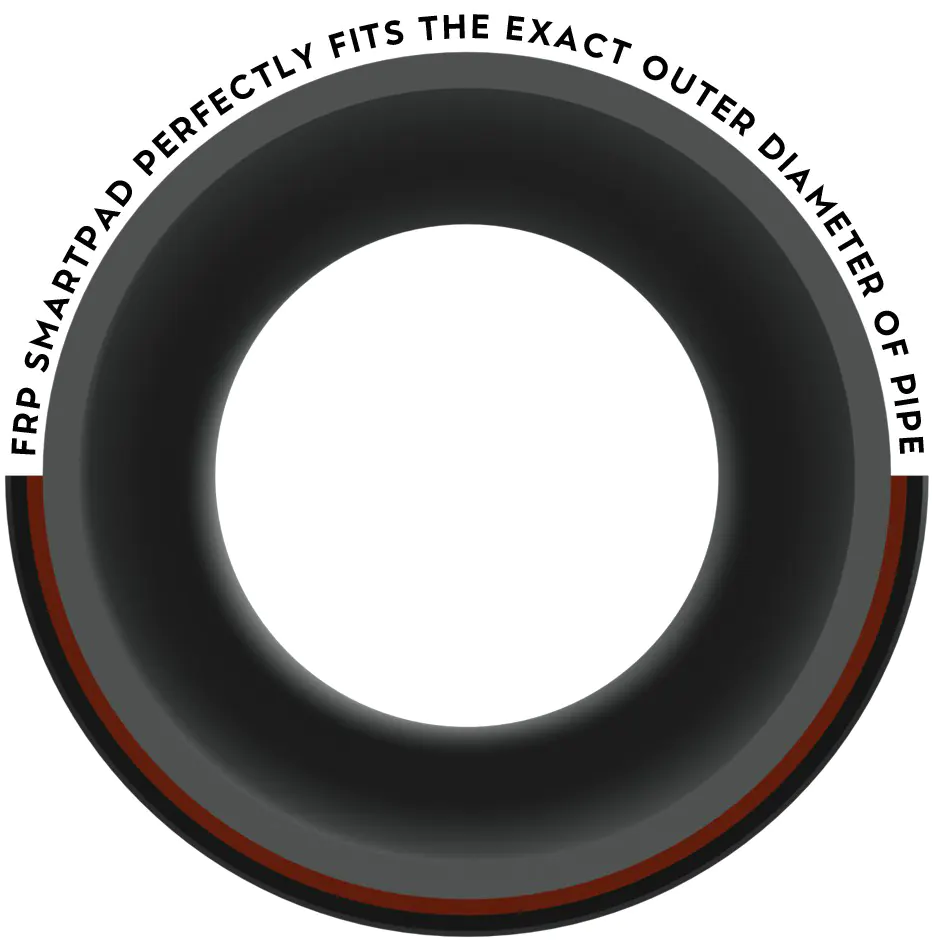
SmartPads are different. They’re manufactured directly to the target pipe diameter, producing an exact 1:1 fit. Because the pad sits naturally flush from the start, the bands don’t need to force it into shape. The edges stay seated because they were molded to belong there.
The FRP Saddle: Strength Through Continuity
Not all FRP materials are created equal. Many supports rely on short‑fiber “chopped” composites, which are convenient but structurally weak. The SmartPad uses continuous‑strand glass reinforcement, which dramatically increases flexural strength and modulus.
This stiffness transforms the pad into a true structural pressure distributor. When band tension is applied, the load doesn’t remain under the band—it spreads evenly across the entire 12‑inch span. Every inch stays sealed because it’s supported by the overall stiffness of the composite “saddle.”

The HydroSeal Gasket: Elastic Energy at Work
If the FRP saddle provides structure, the HydroSeal gasket provides motion. This closed-cell elastomer acts as a mechanical spring that stores energy during compression. Unlike standard gaskets that exhibit compression set, the SmartPad gasket maintains high compression recovery. When compressed during installation, it stores elastic force that constantly pushes back against the pipe surface.
This energy lets the gasket conform to coating variations and ovality across the pipe, ensuring consistent contact and a watertight edge seal.

Friction and the “Static Lock”
A common maintenance question is: “What keeps the pad from sliding or walking due to vibration?”
The answer is static friction created by band tension (strap preload). When the bands are tensioned, they generate a strong radial clamping force, which produces a high normal force at the gasket-to-pipe coating interface. Static friction increases with normal force, so the interface resists the small shear forces that would otherwise cause gradual “walking.” At a microscopic level, the closed-cell gasket conforms to the coating’s surface texture, increasing real contact and micro-mechanical interlock. In practical terms, typical vibration and thermal cycling usually do not exceed the static-friction threshold, so the assembly stays locked in place without any adhesive.
This same friction hierarchy also explains why SmartPads tend to stay indexed to the pipe over time. The gasket-to-pipe interface is intentionally a high-friction, high-preload contact, while the outer FRP saddle against the steel support is comparatively smoother and lower-friction. If the pipe experiences small axial movement relative to the support (from thermal expansion, vibration, or operating cycles), any relative slip tends to occur at the pad-to-support interface rather than between the gasket and the pipe. The result is that the SmartPad assembly tends to move with the pipe, rather than the gasket slipping and the pad migrating out of position.
Why One Inch Inward Is the Sweet Spot
Band placement one inch from each edge isn’t arbitrary—it’s an engineering optimization, as follows:
- It prevents the seesaw effect: Bands placed at the exact edge could slip off corners and create lift on the opposite end.
- It protects the band seat: The one-inch offset ensures that the band’s tension is anchored within solid FRP on both sides.
- It eliminates peel leverage: With only a one-inch overhang, there’s too little lever arm to generate a peeling force that could overcome gasket compression.
This small buffer effectively “short-circuits” the mechanics of edge peeling.
The War on Moisture
The SmartPad’s ultimate mission is to eliminate Corrosion Under Pipe Supports (CUPS). Pads with loose edges act like funnels, pulling in moisture through thermal cycling or rainfall. The SmartPad’s exact‑fit radius and constant compression significantly reduce ingress risk. A tight, positive‑pressure seal denies moisture the opportunity to infiltrate and corrode, protecting the integrity of both pipe and coating.

Thermal Breathing and Vibration Management
Industrial piping expands, contracts, and vibrates constantly. Some traditional welded support configurations constrain movement, which often leads to coating cracks and accelerated corrosion.
SmartPads, by contrast, absorb and adapt to these natural movements. The HydroSeal Gasket flexes as the pipe’s temperature changes, maintaining steady compression and preserving the seal’s integrity through every thermal cycle. At the same time, the combined rigidity of the composite saddle and the elasticity of the gasket dissipate vibration energy. Instead of translating mechanical movement into surface wear, the SmartPad System dampens it; this prevents abrasion, protects coatings, and ensures long-term stability.
Conclusion: Stability by Design
SmartPad edges don’t stay sealed by chance, they stay sealed by design. Through precision molding, structural FRP integrity, and controlled gasket compression, Cogbill has engineered a system whose natural state is sealed stability.
When you see SmartBands placed one inch from the ends, you aren’t looking at a gap. You’re looking at deliberate geometry built for longevity, a mechanical seal designed for a maintenance-free future.